Diode Laser Hair Removal Machine
808nm diode laser for high-volume hair reduction in UK salons. 0-4°C sapphire contact cooling, 12x12mm spot, course-based results across Fitzpatrick I–VI with patch testing on darker skin.
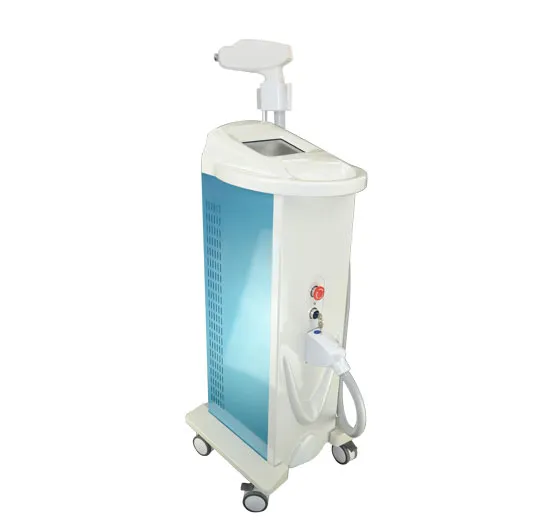
What a diode laser hair removal machine does in a salon
Shopping for a laser hair removal machine for salon work in Great Britain? The 808nm diode is the workhorse. You'll see it on most serious treatment menus. Melanin in the hair follicle soaks up the concentrated beam, turns it into heat, and the follicle loses its ability to regrow. A cooled sapphire tip guards the surface while that happens. Selective photothermolysis is the textbook name. In plain terms, energy parks in the follicle instead of spreading across surrounding skin.
Why 808nm suits high-volume legs, backs and faces
808nm is a compromise, and salons settle on it for good reason. Melanin absorbs it strongly. It still reaches deep enough to hit the follicle. That combination makes it the standard for coarse or dark hair across Fitzpatrick skin types I to VI. Darker skin carries a caveat: post-inflammatory hyperpigmentation is a known risk, so patch test. Our engineering archive rates the 12x12mm spot at 2-100J/cm². Big areas like legs and backs go quickly at that range. Drop the fluence right down for finer upper-lip hair.
Peer-reviewed work backs this up. A 2025 study of Sudanese women with Fitzpatrick skin types IV to VI reports successful hair reduction with adjusted 808nm diode settings. For very dark skin, a 1064nm Nd:YAG device may be the more appropriate tool. Patch test first, always.
Sapphire contact cooling and operator throughput
Cooling isn't only about comfort. It's throughput. Picture a Tuesday-afternoon salon doing back-to-back legs: the 0-4°C sapphire tip lets your therapist keep moving rather than stopping to ice the skin between passes. It protects the epidermis too. That's why the machine can run higher fluence on clients who'd otherwise struggle with the heat.
A 12x12mm spot covers more ground per pulse. Pair that with a 1-10Hz repetition rate and your operator picks the pace that matches the body area. Legs and backs? Faster repeat modes. Smaller or curvier zones where you need placement control? Single pulse.
Single pulse, repeat mode and handpiece replacement
Single-pulse mode is precision work. Upper lip, chin, bikini line, anywhere the energy has to land exactly where you put it. Repeat mode, which some suppliers call sliding or continuous mode, is the one that saves you time on large flat areas. Your staff will flip between the two all day during a mixed clinic.
Now the real holding cost: the handpiece. Shot count is finite, and replacing one is a serious capital decision. Ask your supplier three things. Expected shot count. UK price for a new handpiece. Whether the warranty covers handpiece degradation or only catastrophic failure. That number drives your cost per treatment, not the initial price.
UK device status, laser safety and local licensing
Medical device or purely cosmetic: the two compliance paths
Start with intended purpose. Has the manufacturer declared a medical one? Then the device falls under UK MDR 2002 in Great Britain, and you'll want: UKCA marking or a transitional CE mark, MHRA registration, the name of the UK Responsible Person, a written Declaration of Conformity, and evidence of conformity to EN 60601-1 and EN 60601-2-22.
Marketed purely for cosmetic hair reduction? Then it may sit outside UK MDR 2002 until MHRA reform extends the scope. You're not off the hook. That branch still needs UKCA or CE marking under the Electrical Equipment (Safety) Regulations 2016 and Electromagnetic Compatibility Regulations 2016, a written DoC, a laser classification report to BS EN 60825-1, and English-language instructions and safety labels. Change the MHRA scope and this branch moves onto the medical path. Confirm the classification on the day you order.
Class 4 laser and eye protection
This is a Class 4 laser under BS EN 60825-1. Operator and client both need eye protection specific to 808nm, marked with an optical density rating and compliant with BS EN 207. Check the Declaration of Conformity for the laser classification. Then work out whether your treatment room needs interlocks and warning signs. Your Laser Protection Adviser can set this up before you treat a single client.
Licensing varies across the four nations
England first: check whether your council requires a special treatment licence. London boroughs may operate under the London Local Authorities Act 1991, though outside London only some councils set conditions. Scotland is tidier. Independent clinics using lasers must register with Healthcare Improvement Scotland. Wales is implementing a special procedures regime under the Public Health (Wales) Act 2017, and the current list is narrow, so laser hair removal may or may not be included. Northern Ireland sits under RQIA oversight. The only reliable answer is whatever your own council or regulator says on the day you apply.
Contraindications, patch testing and adverse effects
Screen before you book anyone. Recent sun exposure or tanning. Photosensitising medicines, isotretinoin and some antibiotics among them. Tattoos or pigmented lesions sitting in the treatment area. Active skin infection or cold sores. Any of those, and you delay or refer onward.
Erythema and perifollicular oedema are the common transient effects. They usually settle within hours to a day. The risks that matter more: burns, blistering, hypopigmentation, post-inflammatory hyperpigmentation. Paradoxical hypertrichosis is uncommon, but it does happen. On darker skin tones, PIH is the main concern. Patch test at the same settings, on the intended area, 24-48 hours before the first full session. Keep written informed consent for every client.
Landed cost, VAT and what actually drives price
Landed cost is the machine price plus freight, import duty set by the commodity code, and 20% import VAT. VAT-registered clinics can typically recover that import VAT through postponed VAT accounting, which makes it a cashflow question rather than a true cost per treatment. Not registered? Then the 20% stays in your numbers.
Price tiers differ by power, handpiece life and whether UK-based service comes with it. Entry-level systems suit lower-volume salons. Mid-range machines buy you durability and faster repetition. High-throughput devices are built for all-day clinic use. Our price guide breaks those tiers down without pretending there's one honest UK price. Read the full breakdown.
When you should buy an IPL instead
A diode laser isn't your only option. Say your menu leans on skin rejuvenation, pigmentation and vascular work, hair removal only occasionally. An IPL machine gives you multiple wavelengths and filters on one platform. IPL tends to be less effective on coarse or dark hair than an 808nm diode, and it works best on Fitzpatrick skin types I to IV, so a dedicated hair removal business is better served by the diode. Need one machine covering many treatments? See our IPL machine page, or the diode buying guide.
Specifications
| Laser Type | Diode Laser |
|---|---|
| Laser Wavelength | 808nm |
| Power | 300W (D01) / 600W (D02) |
| Spot Size | 12x12mm² |
| Pulse Width | 1-400ms (Adjustable) |
| Energy | 2-100J/cm² (Adjustable) |
| Frequency | 1-10Hz |
| Cooling System | Air + Semiconductor + Water |
| Cooling Temperature | 0-4°C |
| Weight | 62Kg (D01) / 65Kg (D02) |
Best for
High-volume UK salons and clinics that want a dedicated 808nm diode workhorse for legs, backs and faces, with patch testing built into their protocol for darker skin.
Buy an IPL machine instead if you need one platform covering facial rejuvenation, pigmentation and vascular work alongside occasional hair removal on Fitzpatrick skin types I to IV.
Frequently asked questions
Do I need a special licence to offer laser hair removal in the UK?
Depends where you are. In England, check with your council whether a special treatment licence applies; London boroughs often set conditions, elsewhere only some councils do. Scotland is stricter: independent clinics must register with Healthcare Improvement Scotland. Wales is bringing in special procedures under the Public Health (Wales) Act 2017, but laser hair removal may not be covered yet. Northern Ireland falls under RQIA. Confirm with the relevant body before you open your diary.
How many sessions will my clients typically need?
A course of several sessions, spaced weeks apart. Hair grows in cycles, and only follicles in the active phase respond fully. One visit never does it. Coarse dark hair usually clears faster than fine or light hair. Set expectations around gradual reduction.
What warranty and UK service should I expect?
Ask for the handpiece shot count, warranty terms on handpiece and main unit, and turnaround for spare parts from a UK base. A supplier who won't put confirmed service lead times in writing is a risk to your booking schedule.
Is the 808nm diode safe for darker skin types?
It can be used on Fitzpatrick skin types IV to VI, but only with adjusted settings and a patch test 24-48 hours ahead of the first full session. Post-inflammatory hyperpigmentation is a known risk, so for very dark skin a 1064nm Nd:YAG device may be the more appropriate choice.
Request a quotation
Send your market and configuration needs — the Pmise team replies within 12-24 hours.